pISSN : 3058-423X eISSN: 3058-4302
Open Access, Peer-reviewed

pISSN : 3058-423X eISSN: 3058-4302
Open Access, Peer-reviewed

Kwangjoon Lee,Yongho Jung,Jisoo Kim,Joonsoo Park
10.17966/JMI.2026.31.1.44 Epub 2026 March 31
Abstract
Long-pulsed neodymium-doped yttrium aluminum garnet (Nd:YAG) lasers are widely used in treating onychomycosis, and clinicians have anecdotally observed accelerated nail growth following laser therapy. However, whether laser irradiation influences nail growth in healthy, nononychomycotic nails remains unclear. Herein, we report a single case in which a healthy left great toenail was irradiated with a long-pulsed Nd:YAG laser once weekly for 28 weeks, with the contralateral toenail as an untreated control. At baseline, a superficial groove was created on both great toenails using a CO2 laser to provide a standardized reference point. Nail length from the proximal nail fold to the groove was measured using a direct caliper at baseline and at 4-week intervals up to week 28, and nail growth was calculated per interval. Nail growth between the treated and untreated nails was not significantly different across measurement periods. This case suggests that repeated long-pulsed Nd:YAG laser irradiation does not measurably accelerate nail growth in healthy toenails. Thus, further studies involving larger cohorts are warranted to clarify the relationship between laser therapy and nail growth dynamics.
Keywords
Laser therapy Nd:YAG laser Toenail growth
Long-pulsed neodymium-doped yttrium aluminum garnet (Nd:YAG) lasers have been adopted in dermatology for various indications, such as in the adjunctive treatment of onycho- mycosis1. Clinicians skilled in laser treatment of onychomycosis sometimes report an apparent acceleration of nail regrowth following laser therapy2,3. Proposed mechanisms include direct antifungal thermal effects, temperature-mediated changes in local microcirculation, and stimulation of local inflammatory responses that may have secondary effects on nail matrix activity. However, whether laser irradiation can hasten nail growth rate in the absence of fungal infection has not been established.
Herein, we evaluate the effect of repeated long-pulsed Nd: YAG laser irradiation on toenail growth in a healthy individual without onychomycosis.
The patient was a healthy, 47-year-old Korean man (an author of this study). He had no underlying medical con- ditions, and neither clinical nor laboratory findings suggested onychomycosis involving either great toenail.
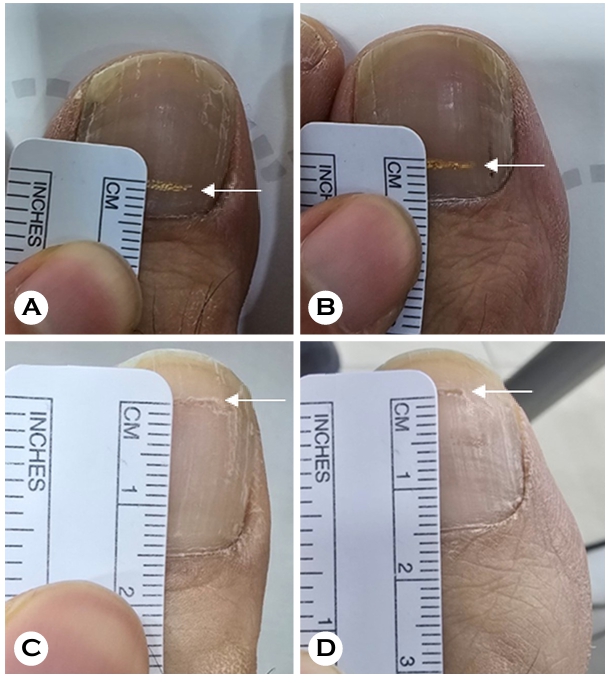
A long-pulsed Nd:YAG laser (Sandro Dual®, Wontech, Korea) was used to irradiate the left great toenail (left hallux) only. Laser was delivered with a spot size of 5 mm, fluence of 40 J/cm2, and pulse duration of 30 ms, and treatment sessions were conducted once weekly for 28 weeks. Each treatment session consisted of three passes over the entire nail plate, with an approximate 10-20% overlap between adjacent laser spots. No external cooling device was used during irradiation. The growing nail was not subjected to any trimming standardization or additional management during the study period. The selected laser parameters were adopted from previously published Nd:YAG laser treatment protocols for onychomycosis. At baseline (week 0), a superficial longi- tudinal groove was made on both great toenails using a CO2 laser at a standardized position as a consistent reference mark. The distance from the proximal nail fold to the groove was measured using a direct caliper (precision 1 mm) (Fig. 1). Measurements were repeated at 4-week intervals (weeks 4, 8, 12, 16, 20, 24, and 28) (Table 1). Nail growth per interval was calculated as the difference in the measured distance between successive 4-week time points (Table 2).
|
Variable |
Laser treated nail |
Untreated control nail |
|
Baseline |
5 |
4 |
|
Week 4 |
6 |
5 |
|
Week 8 |
8 |
7 |
|
Week 12 |
10 |
9 |
|
Week 16 |
11 |
10 |
|
Week 20 |
12 |
11 |
|
Week 24 |
14 |
13 |
|
Week 28 |
15 |
15 |
|
Interval |
Laser treated nail |
Untreated control nail |
|
0-4 |
1 |
1 |
|
4-8 |
2 |
2 |
|
8-12 |
2 |
2 |
|
12-16 |
1 |
1 |
|
16-20 |
1 |
1 |
|
20-24 |
2 |
2 |
|
24-28 |
1 |
2 |
As shown in Table 2, the cumulative measurements over the 28-week study period revealed that the laser-treated nail grew a total of 10 mm (from 5 mm at baseline to 15 mm at week 28), whereas the untreated control nail grew 11 mm (from 4-15 mm). The analysis of the growth rates at 4-week intervals revealed that the two nails exhibited identical interval growth distances in six out of the seven measured periods. Notably, the untreated control nail exhibited 1 mm of add- itional growth compared with the treated nail specifically during the final interval between weeks 24 and 28.
The precise mechanism by which long-pulsed Nd:YAG laser therapy exerts its therapeutic effect on onychomycosis has not yet been fully clarified.
Several studies reporting the efficacy of long-pulsed Nd:YAG lasers for treating onychomycosis have suggested that a photothermal effect may induce a fungicidal action4,5. In vitro studies have also demonstrated the eradication of fungi or reduction in colony size in fungal culture media following laser irradiation6. Fungicidal activity requires maintenance of temperatures between 50℃ and 55℃ for several minutes7,8. However, exposure to temperatures of approximately 50℃ for >2 min or 55℃ for approximately 10 s can result in second-degree or more severe burns9,10. Therefore, achieving a truly fungicidal effect through laser irradiation would inevitably be accompanied by at least second-degree burn.
From a practical and clinical standpoint, it is unlikely that a fungicidal effect can be safely achieved with laser therapy alone. Conversely, a fungistatic effect requires maintaining temperatures above 45℃ for several minutes, and tempera- tures < 48℃ are generally not associated with significant thermal injury to the skin. Accordingly, the antifungal action of laser therapy is more likely to be fungistatic rather than fungicidal.
Nail growth is impaired in the presence of onychomycosis, and more evident growth inhibition is observed when >50% of the nail plate is involved7,8. Considering that itraconazole, a fungistatic antifungal agent, can restore normal nail growth, a fungistatic effect induced by long-pulsed Nd:YAG laser therapy may contribute to the normalization of the nail growth rate in patients with onychomycosis7,8.
Additional hypotheses include laser-induced thermal stimu- lation of local blood flow or induction of localized inflam- matory responses, which may promote nail growth in the subsequent healing process9,10. However, as demonstrated in this report of a single case, long-pulsed Nd:YAG laser irra- diation did not accelerate nail growth in a healthy individual without onychomycosis. This finding suggests that growth-promoting effects potentially related to increased local blood flow or inflammation-induced regenerative responses were not observed in a nail without fungal infection, and their role in nail growth under different clinical conditions cannot be excluded.
Mechanisms such as increased local blood flow or inflammation-induced regenerative responses are unlikely to affect nail growth in the absence of fungal infection.
Limitations of this report include the single-patient design, absence of blinding, and potential measurement error despite standardized marking. Findings from a single case may not be generalizable to the general population. The groove marking technique and caliper-based measurement approach may have limited resolution and may not fully capture very subtle changes. Future studies may consider the use of higher-precision digital calipers with submillimeter resolution (e.g., 0.1 mm) or digital photography incorporating a standardized scale marker, followed by image-based length measurement. Finally, because the patient was also the author who per- formed the treatment, potential observer and performance bias cannot be excluded.
In this report of a single case, repeated long-pulsed Nd:YAG laser irradiation over 28 weeks did not result in a clinically meaningful acceleration of nail growth in a healthy, nononychomycotic toenail. Thus, the clinical impression of accelerated nail growth observed during laser therapy for onychomycosis may be related to the restoration of impaired nail growth following fungal clearance rather than a direct growth-stimulatory effect of laser irradiation. However, given the single-patient design and methodological limitations, these observations should be interpreted cautiously.
Although growth-promoting effects potentially related to increased local blood flow or inflammation-induced regen- erative responses were not observed in a nail without fungal infection, the potential contribution of these mechanisms under pathological conditions cannot be excluded. Thus, further studies involving larger study populations, standard- ized measurement methods, and inclusion of patients with onychomycosis or other nail disorders may better clarify the biological and clinical effects of laser therapy on nail growth dynamics.
References
1. Lipner SR, Scher RK. Onychomycosis: Clinical overview and diagnosis. J Am Acad Dermatol 2019;80:835-851
Google Scholar
2. Rivers JK, Vestvik BJ, Berkowitz J. Real-World efficacy of 1,064-nm Nd:YAG laser for the treatment of onycho- mycosis. J Cutan Med Surg 2017;21:108-113
Google Scholar
3. Wanitphakdeedecha R, Thanomkitti K, Bunyaratavej S, Manuskiatti W. Efficacy and safety of 1,064-nm Nd:YAG laser in treatment of onychomycosis. J Dermatolog Treat 2016;27:75-79
Google Scholar
4. Okan G, Tarikci N, Gokdemir G. The effect of long-pulsed Nd:YAG laser for the treatment of onychomycosis. J Am Podiatr Med Assoc 2017;107:54-59
Google Scholar
5. Kiran A, Khan S, Ahmed N, Ali M. Efficacy of Nd:YAG laser 1,064-nm in the treatment of onychomycosis. J Coll Physicians Surg Pak 2024;34:757-760
Google Scholar
6. Bristow IR. The effectiveness of lasers in the treatment of onychomycosis: A systematic review. J Foot Ankle Res 2014;7:34
Google Scholar
7. Gupta AK, Stec N, Summerbell RC, Shear NH, Piguet V, Tosti A, et al. Onychomycosis: A review. J Eur Acad Dermatol Venereol 2020;34:1972-1990
Google Scholar
8. Leung AKC, Lam JM, Leong KF, Hon KL, Barankin B, Leung AAM, et al. Onychomycosis: An updated review. Recent Pat Inflamm Allergy Drug Discov 2020;14:32-45
Google Scholar
9. Ma W, Si C, Kasyanju Carrero LM, Liu HF, Yin XF, Liu J, et al. Laser treatment for onychomycosis: A systematic review and meta-analysis. Medicine (Baltimore) 2019;98: e17948
Google Scholar
10. Chandrashekar BS, Madura C, Shenoy C, Chandar A, Roopa MS, Narayana NL. Laser treatment in nail dis- orders: A comprehensive review. Indian Dermatol Online J 2024;16:59-71
Google Scholar
Congratulatory MessageClick here!